Stupid Shoes: What the Barefoot Documentary Gets Right, What Needs More Evidence, and What to Do Next
Where I land, before the detail
Where I land before the detail:
- The strong bit: badly fitting shoes are common, and narrow toe boxes are associated with bunions and other foot problems.
- The interesting bit: minimalist footwear appears capable of increasing foot strength, although the evidence is still developing.
- The bit I’m not convinced by yet: claims that modern shoes are responsible for a health crisis “bigger than diabetes”, or a specific multi-billion-dollar burden.
The practical case for paying more attention to shoe shape is already interesting. It does not need the biggest claims to be true.
Evidence confidence
The evidence at a glance
A summary of where the current evidence is relatively strong, where it is still developing, and where a claim is not yet established.
Fit and toe-box shape
Poor fit is common, and narrower footwear is associated with hallux valgus and other foot problems.
Foot strength
Minimalist footwear and foot-focused exercise can improve strength measures, but certainty is still limited.
“Bigger than diabetes”
I could not find a defensible estimate showing that footwear-attributable disease exceeds the burden of diabetes.
What the evidence can tell us
Is there a plausible way footwear could affect the outcome?
Do studies actually observe or test that effect?
How far can the claim reasonably go?
A plausible mechanism is useful, but the strength of the claim should follow the strength of the evidence.
What interests me about Stupid Shoes is the question behind it: have we spent so long designing shoes around fashion, convention and manufacturing that we stopped asking whether they make sense for the feet going inside them?
I obviously come to this with a bias. I run Minimal-list. I already think most people would benefit from paying more attention to shoe shape and fit.
But that makes me more interested in separating the good argument from the overcooked one, not less.
The film’s campaign makes some very big claims. Some look well grounded. Some are plausible but not settled. A few go further than I think the available evidence allows.
The useful question is not “are normal shoes bad?” It is: which parts of modern shoe design actually matter for foot health, and how confident are we?
Start with the boring question: does the shoe actually fit?
Before zero drop, cushioning, arch support or whether your shoes can be rolled into a tiny burrito, there is a simpler question.
Does the shoe actually fit the foot?
A 2018 review by Buldt and Menz found that roughly 63–72% of participants were wearing shoes that did not properly accommodate the length or width of their feet. Incorrect fit was also associated with foot pain, corns, calluses and lesser-toe deformity.
That result matters because it does not require you to buy into a barefoot philosophy.
If your forefoot is wider than the shoe around it, the shoe is changing the space available to your toes while you wear it. That does not prove it will cause a particular injury. But it gives us a very sensible place to start.
The bunion question is stronger than I expected
Hallux valgus, the medical term for a bunion, is clearly not explained by shoes alone. Genetics, anatomy, age and sex all matter.
Still, footwear looks relevant.
A 2026 systematic review and meta-analysis found narrow-toed footwear was associated with about 2.25 times the odds of hallux valgus compared with wider footwear. High heels were also associated with higher odds.
The limitation is important: most of the underlying evidence is observational, and the authors rated its certainty low or very low.
So I would not write “narrow shoes cause bunions” and move on. I would write that narrow shoes look like a meaningful contributor to bunion risk, alongside other factors.
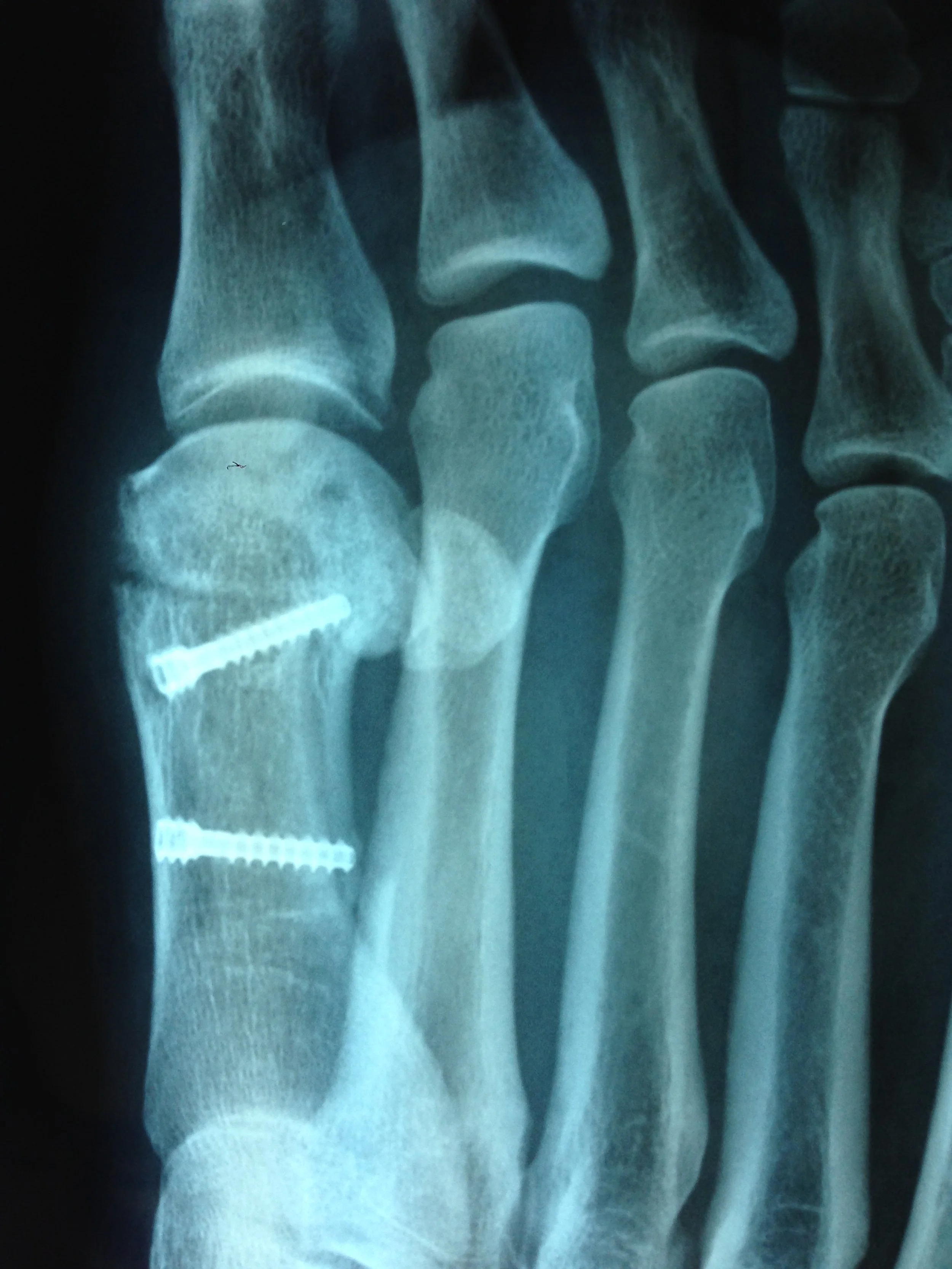 Dee Libine’s foot X-ray, published on the official Stupid Shoes site. Her own bunion surgery helped start the investigation behind the film.
The most interesting evidence is what happens when feet do more work
This is the part I find most compelling, because we can move beyond association and look at interventions.
A 2025 systematic review and meta-analysis of 28 trials found that minimalist footwear and foot-focused exercise can improve measures of foot strength, including strength in the lesser toes. The certainty of the evidence was still low to very low.
A smaller six-month intervention published in 2021 also found a large increase in measured foot strength among people who increased their daily use of minimal footwear.
That makes sense mechanically. Feet contain muscles, tendons and joints that respond to load. If footwear asks those structures to do more, some adaptation is exactly what you would expect.
Where I stop is the next leap.
Stronger feet do not automatically mean fewer injuries. They do not prove that everyone should remove cushioning or arch support. And they definitely do not prove that barefoot shoes are a treatment for every kind of foot pain.
Where the film’s campaign starts to lose me
The promotional material around Stupid Shoes uses some brilliant hooks. The bigger the hook, though, the more evidence it needs.
“245 years of ignored science”
This one has a surprisingly good historical anchor.
In 1781, Dutch anatomist Petrus Camper published On the Best Form of Shoe, criticising shoes that squeezed and deformed the toes. From 1781 to 2026 is exactly 245 years.
I love this because it kills the idea that concerns about shoe shape were invented by Instagram barefoot people five minutes ago.
“Ignored science” is harder to defend literally. Plenty of people have studied feet and footwear during those 245 years. What seems fairer is that concerns about toe compression have existed for centuries without changing mainstream shoe design very much.
“A multi-billion-dollar health crisis”
Musculoskeletal disease carries an enormous economic burden. That part is not controversial.
The problem is attribution.
We can show that musculoskeletal conditions cost society huge amounts of money. We can show that footwear is associated with some foot problems. What I have not found is a credible bridge that lets us take a slice of the total musculoskeletal bill and say: this much was caused by modern shoes.
That does not mean the documentary cannot make a case for a substantial footwear-related burden. It means the specific attribution needs evidence that separates footwear from the much larger total burden of musculoskeletal disease.
“Bigger than diabetes”
This is the claim I would be most cautious with.
The Global Burden of Disease 2021 analysis estimated that 529 million people were living with diabetes in 2021, accounting for roughly 79 million disability-adjusted life years.
Musculoskeletal disease as a whole is also enormous. But comparing all musculoskeletal disease with diabetes is not the same as showing that footwear-related disease is bigger than diabetes.
To make that claim convincingly, you need a credible estimate of how much disease is actually attributable to footwear. I have not found one.
The funny thing is, I don’t think Stupid Shoes needs the huge claims
The more I dug into this, the less I thought the case needed dramatic numbers.
We already know enough to ask better questions about shoes:
- Badly fitting footwear is common.
- Narrow toe boxes are associated with hallux valgus.
- Foot pain is common and can interfere with movement.
- Feet appear capable of becoming stronger when footwear asks them to do more.
That is already a useful argument.
The least dramatic idea may also be the most useful one: a shoe should probably give a foot enough room to behave like a foot.
Four questions worth asking about claims like these
Big health claims are easiest to evaluate when you break them into a few simpler questions.
- Does the evidence show association or causation? A relationship between footwear and a condition is useful evidence, but it is not automatically proof that the footwear caused it.
- Where do the economic estimates come from? A large total burden for musculoskeletal disease does not tell us how much of that burden is attributable to footwear.
- Are the trade-offs acknowledged? More minimal footwear changes where and how the body is loaded; it does not simply remove load.
- Do the recommendations follow from the evidence? A plausible mechanism is not enough on its own to justify a universal prescription.
Those questions are useful well beyond this documentary. They are a good filter for almost any strong health or footwear claim.
So what should you actually look for in a shoe?
I would start with fit rather than ideology.
- Enough length. Your toes should not be hitting the front.
- Enough width. Your forefoot should not be compressed just to match the outline of the shoe.
- Space for your toes. They should not be permanently pushed together.
- The right amount of cushioning and support for you. More minimal is not automatically better in every context.
- Time to adapt. Moving toward more minimal footwear is a change in training load, not just a fashion swap.
If you want to see what that looks like in practice, we’ve built three useful places to start:
How to watch Stupid Shoes
For current viewing options and information about the documentary, see the official Stupid Shoes site.
What this article is - and isn’t
This is an evidence review of the main public claims surrounding Stupid Shoes, not a scene-by-scene review of the documentary. The conclusions above are based on the published research and public claims cited here.
That distinction matters. A documentary can be valuable for starting a conversation even where some of its broader framing goes beyond what the available evidence can establish.
References
- Buldt AK, Menz HB. Incorrectly fitted footwear, foot pain and foot disorders. 2018.
- Zhang G, Ma Y, Zhang S. Determinants and associated factors for hallux valgus: systematic review and meta-analysis. 2026.
- Peters-Dickie JL et al. Foot core exercises and minimalist footwear: systematic review and meta-analysis. 2025.
- Curtis R et al. Daily activity in minimal footwear increases foot strength. 2021.
- GBD 2021 Diabetes Collaborators. Global burden of diabetes, 1990–2021.
- Petrus Camper. On the Best Form of Shoe. 1781.